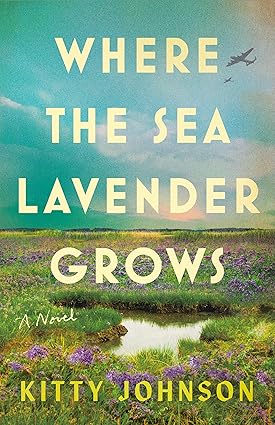
Thank you for joining me today, Jessica’s 9th Epilogue is a review of: Where the Sea Lavender Grows by Kitty Johnson.
Where the Sea Lavender Grows is a historical fiction that takes place in Norfolk, England. The book follows the alternating storylines that encompass two different time periods and the women who are living at the historic cottage, The Marsh House. In present day, Elise, an artist, is seeking her own refuge to cope with her crumbling marriage that is a result of her and her husband losing their young son after his battle with cancer. Seeking distraction, she accepts a job to restore the paintings and murals at Marsh House, originally created by its former owner, Lilias (Lily) Carter-Brown. She quickly becomes occupied not only with painting and brushwork but also is compelled to uncover the underlying truths behind mysteries that have still been unresolved for decades. The alternating storyline then immerses us in the journey of Lilias, who in 1939 opened the doors of her home to WWII refugees from London. She develops unexpected bonds with the young refuge boy, David, and his father, Harry.
With Elise’s immediate connection to the Marsh House, she becomes the sole detective to uncover the mystery of the past. Who was the refugee boy? What happened to him? Where is Harry and what has become of Lily? And why does the old photograph of the refuge boy look so much like her son?
I obtained a copy of this book through Amazon First Reads. This book was perfect for me as I have a soft-heart for historical fiction and learning about history. I found the story line and characters incredibly engaging and completed the entire book from cover to cover in one day. First, I loved that this story began because of one simple thing:
“And the photograph had been the start of everything.”.
How many times do we stop and look at photographs and find ourselves diving into the memory or the photo or finding a photo and wondering, what were there people doing? Who is that? What was it like to like back then? I absolutely loved that one photograph inspired one of the main characters to seek answers. It started with a photo of a boy who looked like her recently deceased son and turned into finding the truth for decades-long mysteries. I love the idea that Elise a truth-seeker. She wants to know more and find out what happened to the prior residents, who no doubt lived through such a dark time in world history during WWII.
Not only that aspect, but I was able to check mark several boxes for what I look for with a historical fiction novel. I love reading about the difference makers and small story lines of those that were selfless during WWII. WWII is always an immensely tough read and I’m a firm believer that through all the things that are ugly, there is still the ability to find what was good. With the anguish of families split apart, death on the front lines and the hatred, there are still countless stories of the brave and courageous people who created sanctuaries for children, soldiers, downed allies or worked behind the scenes to infiltrate Nazi plans. This book, gives us a glance into how normal, everyday women and families helped during this time period, providing a countryside sanctuary outside of the cities that were at high-risk for Nazi bombings and air raids.
I loved the setting of this novel, it’s a picture perfect setting with the backdrop of salt marshes and sea lavender. Through the author’s writing, I can tell how much Lilias loved the property and surrounding beauty of the Marsh House. The house ultimately becomes the epi-center of the grief process. It pulls in characters and people that are not in their prime light, they all are struggling with battles and conflict but the house helps them overcome and feel the sense of belonging, it helps them mend friendships, helps them discover their new paths and gives them opportunity to nurture familial roots. In a sense, the Marsh House became an influential character of the book. We too see its character thrive, become lost and then see the yearning for its own healing and restoration.
The alternating story line gave me a unique perspective of each of the different characters and how they are influenced by grief. Two of the leading characters, Elise and Lily, find immense strength and sanctuary at the Marsh House. The relationship that I loved most was the that of Lily and the young refugee boy, David. As David is forced to live away from his own parents for his safety and survival from Nazi bombings during WWII. Lilias is no stranger to her own heartache and grief but still has the ability to meet David where he is. She tenderly guides and loves him, caring for him deeply while he lives with her at The Marsh House.
I also loved the artistic descriptions in this book, from the murals and paintings on the wall, to the cushions, I was able to create picture-perfect scenes in my mind. I loved all the connections to art and sat in awe of Lily’s stunning creations, all of which were inspired by the Norfolk seaside. It’s always so inspiring to me that artists can take images and places that they love and perfectly, carefully replicate them.
This story isn’t only about loss; it also highlights love, kindness, courage, healing, and renewal. And this isn’t just about art restoration and preserving the past, but it’s a story of personal restoration, the discovery of who you are or who you should be, where you came from and overcoming the obstacles that stop us in our tracks.
When I read this passage, I got a great sense of how overcome with grief, The Marsh House, must have been:
“The garden was overrun by weeds. Tall thistles, stinging nettles, dandelions, and grasses. Someone had bashed at them to keep the path to the front door clear, but for someone with an imagination, it was all too easy to imagine the weeds growing in the night, closing over the path again to trap you in the house like in some macabre fairy story.”
It relatable because as a human, we certainly can’t be perfect and sometimes the most beautiful of places and people can be overloaded with profound grief, this passage forces you to image that you could feel this way. After reading this passage, my heart was hopeful that this story would not just restore the characters but that we would find restoration of the property and that this beautiful sanctuary would be redeemed and find its own beauty again. It was gratifying to see both the restoration of the house and the renewal experienced by many of the characters. I also absolutely loved the ending, truth always wins!
Check this book out if you:
- Love reading historical fiction set in the time period during WWII.
- Look for the ‘difference makers’ during tragedy or times of conflict.
- Love genuine characters, they are raw, relatable and imperfect.
Skip this if you:
- Struggle with reading of grief, child/infant loss
- Don’t like reading or have a disbelief in supernatural things
Overall, I rated this 4 stars on Good Reads and would consider reading other books written by her. This is her fourth book published under her name, Kitty Johnson but she has also written under her pen-name: Margaret K. Johnson:
- Five Winters- Kitty Johnson
- Prickly Company- Kitty Johnson
- Closest Kept- Kitty Johnson
- The Dare Club- Margaret K. Johnson
- Perfect Responses- Margaret K. Johnson
- The Goddess Workshop- Margaret K. Johnson
Check her out at her website: https://www.kittyjohnsonbooks.com/
Let me know if you plan to read this book or have checked out any of her other published books.


Leave a Reply